


INTERNATIONAL ACADEMIC CONFERENCE HELD ON “DIPLOMATIC POLICY OF THE GREAT MONGOL EMPIRE: HISTORY AND MODERNITY”
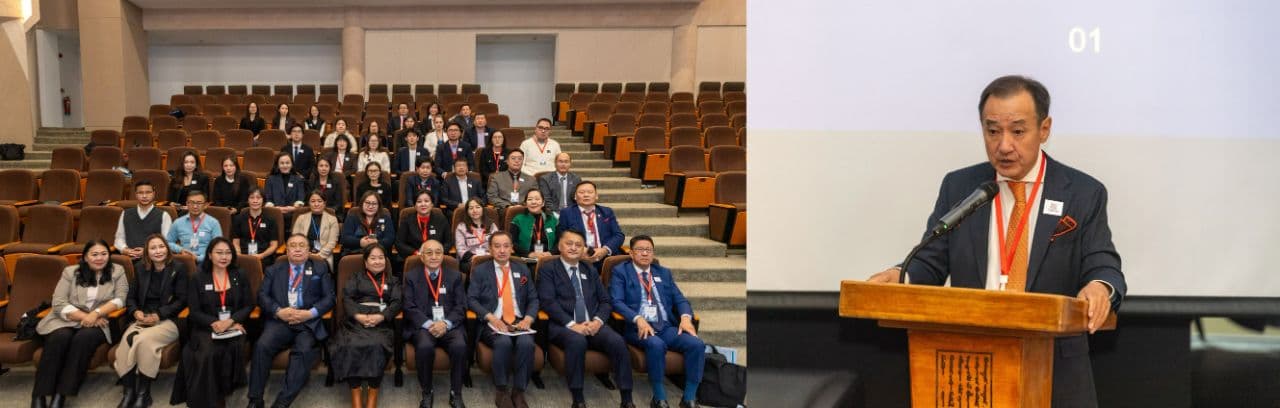
In support of the academic, educational, and research activities of the National University of Mongolia, the Chinggis Khaan National Museum co-organized an international academic conference titled “Diplomatic Policy of the Great Mongol Empire: History and Modernity” on October 28, 2026.
More than 30 Mongolian and international scholars and researchers from various disciplines gathered to examine and discuss the achievements and historical contributions of Chinggis Khaan, including the establishment of the Ikh Zasag, applicable throughout the Great Mongol Empire, the introduction of gold and silver gerege (official credentials and diplomatic passes) as the foundation of diplomatic relations, the implementation of the decimal military organization based on units of one thousand, and the establishment of the Keshigten, the Great Khaan’s imperial guard. The conference also explored his broader contributions to Mongolia and the world.
The conference was opened by G. Byambaragchaa, Head of the Research and Collections Center of the National Museum of Chinggis Khaan, who stated “The diplomatic policy of the Great Mongol State was never limited to politics alone. For more than 800 years, it has continued to evolve in the political and economic spheres. Today, this diplomatic policy is expanding into cultural diplomacy, with the National Museum of Chinggis Khaan taking a leading role in this development.”
The keynote presentation was delivered by D. Tsogtbaatar, Member of the State Great Khural (Parliament) of Mongolia. He emphasized that the legacy left by Chinggis Khaan continues to this day and provided insights into its significance from the perspective of international law.
Researchers from the Chinggis Khaan National Museum also presented papers on a range of topics, including: G. Uranbayar, Senior Officer at the Research and Collection Center: "The Influence of Gold-Thread Silk Production During the Mongol Empire on Diplomatic Relations", Ts. Egiimaa, Researcher, “Distinctive Features of the Clothing and Adornments of Noblewomen During the Mongol Empire.” A. Chadankhuu, Researcher, “The Mongol Empire and Its Relations with Armenian Churches and Monasteries.” B. Batbaatar, Researcher, “Protocols and Traditions for Receiving Foreign Envoys and Delegations at the Courts of the Great Khans.”
The conference brought together Chinggis Khaan scholars and researchers from Russia, China, France, Australia, Pakistan, and other countries, alongside academics from the National Museum of Chinggis Khaan; the School of International Relations and Public Administration and the School of Law at the National University of Mongolia, the Institute of International Studies of the Mongolian Academy of Sciences, the Institute of Brain and Psychology, Ikh Zasag University, the Plekhanov Russian University of Economics branch in Ulaanbaatar, the Parliamentary Research Institute under the State Great Khural, the Institute for Strategic Studies, and other academic and research institutions.
Following the conference, the presented papers will be compiled and published in a special issue by the international academic publisher Brill.